Chapter 10 Group clustering
How to group sites according to dissimilarity of community compositions?
10.1 Hierarchical: Ward’s clustering
Ward’s clustering is a hierarchical cluster analysis method based on community dissimilarities (Murtagh and Legendre 2014). In this approach, we can set the number of groups a priori for visualization and assigning group membership.
k   <- 7                                          # specify number of groups
cl  <- hclust(D, method='ward.D2')                # clustering solution
grp <- cutree(cl, k)                              # group memberships
plot(cl) ; rect.hclust(cl, k, border=rainbow(k))  # plot the dendrogram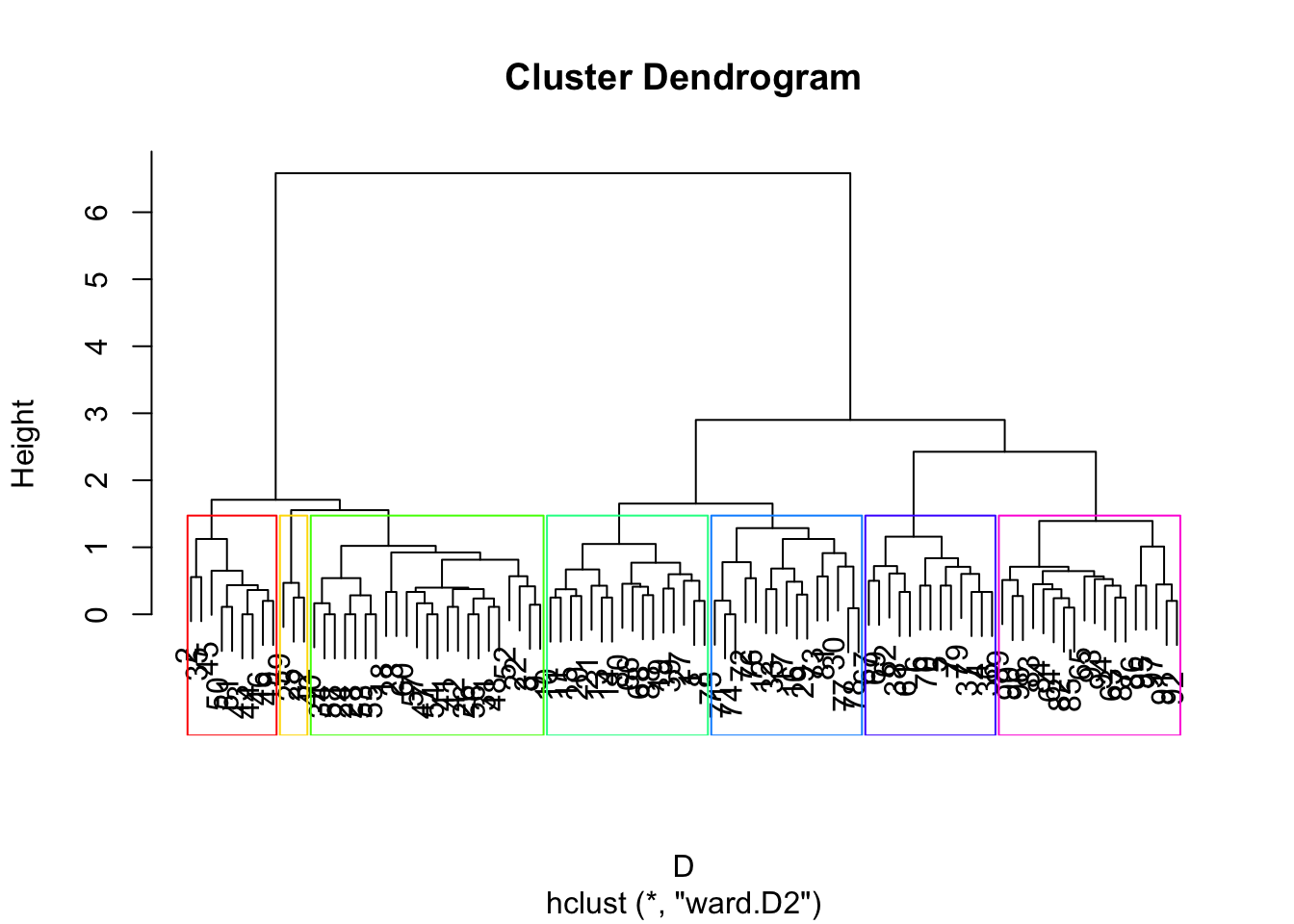
NOTE: Height represents the amount of within-cluster variation introduced when clusters are merged. Clusters that join at low heights are very similar, whereas clusters that join at high heights are much more distinct.
10.2 Non-hierarchical: fuzzy clustering
Non-hierarchical methods also exist. And, it may be useful to define groups based on fuzzy rather than crisp partitions, using fuzzy clustering (de Caceres et al. 2010).
## Loading required package: vegclustns <- 1 # number of random starts (increase for real analyses!)
k <- 7 # number of groups is specified in advance
# fuzzy c-means
cl <- vegclustdist(D, mobileMemb=k, method='FCM', m=1.2, nstart=ns)
# fuzzy c-means with a noise cluster
cl_a <- vegclustdist(D, mobileMemb=k, method='NC', m=1.2, dnoise=0.8, nstart=ns)
# fuzzy c-medoids
cl_b <- vegclustdist(D, mobileMemb=k, method='FCMdd', m=1.2, nstart=ns)
# crisp k-means
cl_c <- vegclustdist(D, mobileMemb=k, method='KM', nstart=ns)
# how well do the other methods agree with fuzzy c-means?
concordance(cl, cl_a)## adjustedRand
## 0.8224128## adjustedRand
## 0.6162529## adjustedRand
## 0.5436687Let’s examine group memberships grp from the fuzzy clustering. While memberships are fuzzy, we can ask for a crisp membership based on a threshold or else the maximum fuzzy membership.
##     M1   M2   M3   M4  M5   M6   M7
## 1 0.00 0.97 0.01 0.00 0.0 0.00 0.01
## 2 0.00 0.00 0.00 0.89 0.1 0.01 0.00
## 3 0.00 0.00 0.00 0.10 0.9 0.00 0.00
## 4 0.00 0.00 0.00 0.00 0.0 0.04 0.96
## 5 0.03 0.02 0.00 0.00 0.0 0.64 0.31
## 6 0.00 0.00 0.00 0.00 0.0 1.00 0.00## 1 2 3 4 5 6 7 8 9 10 11 12 13 14 15 16
## "M2" "M4" "M5" "M7" NA "M6" "M6" "M2" "M5" "M2" "M2" "M7" "M2" "M2" "M2" "M7"
## 17 18 19 20 21 22 23 24 25 26 27 28 29 30 31 32
## "M7" "M5" "M2" "M2" NA "M5" "M5" "M5" "M5" "M5" "M2" "M5" NA NA "M5" "M5"
## 33 34 35 36 37 38 39 40 41 42 43 44 45 46 47 48
## "M7" "M5" NA "M6" "M7" "M6" "M2" "M5" "M5" "M5" "M4" "M4" "M4" "M4" "M5" "M5"
## 49 50 51 52 53 54 55 56 57 58 59 60 61 62 63 64
## "M4" "M4" "M4" NA "M5" "M5" "M5" "M5" "M5" "M5" "M3" "M5" "M6" "M6" "M1" "M1"
## 65 66 67 68 69 70 71 72 73 74 75 76 77 78 79 80
## "M1" "M2" "M6" "M2" "M6" NA "M3" "M3" "M3" "M3" "M3" "M1" "M3" "M3" NA "M2"
## 81 82 83 84 85 86 87 88 89 90 91 92 93 94 95 96
## "M3" "M1" "M1" "M1" "M1" "M1" "M1" "M2" "M1" "M1" "M7" "M7" "M1" "M1" "M1" "M1"
## 97
## "M1"## 1 2 3 4 5 6 7 8 9 10 11 12 13 14 15 16
## "M2" "M4" "M5" "M7" "M6" "M6" "M6" "M2" "M5" "M2" "M2" "M7" "M2" "M2" "M2" "M7"
## 17 18 19 20 21 22 23 24 25 26 27 28 29 30 31 32
## "M7" "M5" "M2" "M2" "M2" "M5" "M5" "M5" "M5" "M5" "M2" "M5" "M7" "M2" "M5" "M5"
## 33 34 35 36 37 38 39 40 41 42 43 44 45 46 47 48
## "M7" "M5" "M4" "M6" "M7" "M6" "M2" "M5" "M5" "M5" "M4" "M4" "M4" "M4" "M5" "M5"
## 49 50 51 52 53 54 55 56 57 58 59 60 61 62 63 64
## "M4" "M4" "M4" "M5" "M5" "M5" "M5" "M5" "M5" "M5" "M3" "M5" "M6" "M6" "M1" "M1"
## 65 66 67 68 69 70 71 72 73 74 75 76 77 78 79 80
## "M1" "M2" "M6" "M2" "M6" "M6" "M3" "M3" "M3" "M3" "M3" "M1" "M3" "M3" "M1" "M2"
## 81 82 83 84 85 86 87 88 89 90 91 92 93 94 95 96
## "M3" "M1" "M1" "M1" "M1" "M1" "M1" "M2" "M1" "M1" "M7" "M7" "M1" "M1" "M1" "M1"
## 97
## "M1"## grp
## M1 M2 M3 M4 M5 M6 M7 <NA>
## 18 17 9 9 25 10 9 0Compare fuzzy clusters to Ward clusters
##
## grp   1  2  3  4  5  6  7
##   M1  0  0  0  1  1  0 16
##   M2 16  0  0  0  1  0  0
##   M3  0  0  0  0  8  1  0
##   M4  0  9  0  0  0  0  0
##   M5  0  0 23  0  0  2  0
##   M6  0  0  0 10  0  0  0
##   M7  0  0  0  2  5  0  2
The Ward and fuzzy clustering solutions show substantial agreement, with several fuzzy clusters corresponding closely to individual Ward clusters. However, some Ward groups, especially clusters 5, 6, and 7, are split across multiple fuzzy clusters, suggesting that these communities may represent transitional or less clearly separated assemblages.
10.3 Key references
de Caceres, M., X. Font, F. Oliva. 2010. The management of numerical vegetation classifications with fuzzy clustering methods. Journal of Vegetation Science 21: 1138–1151.
Murtagh, F., and P. Legendre. 2014. Ward’s hierarchical agglomerative clustering method: which algorithms implement Ward’s criterion? Journal of Classification 31: 274–295.